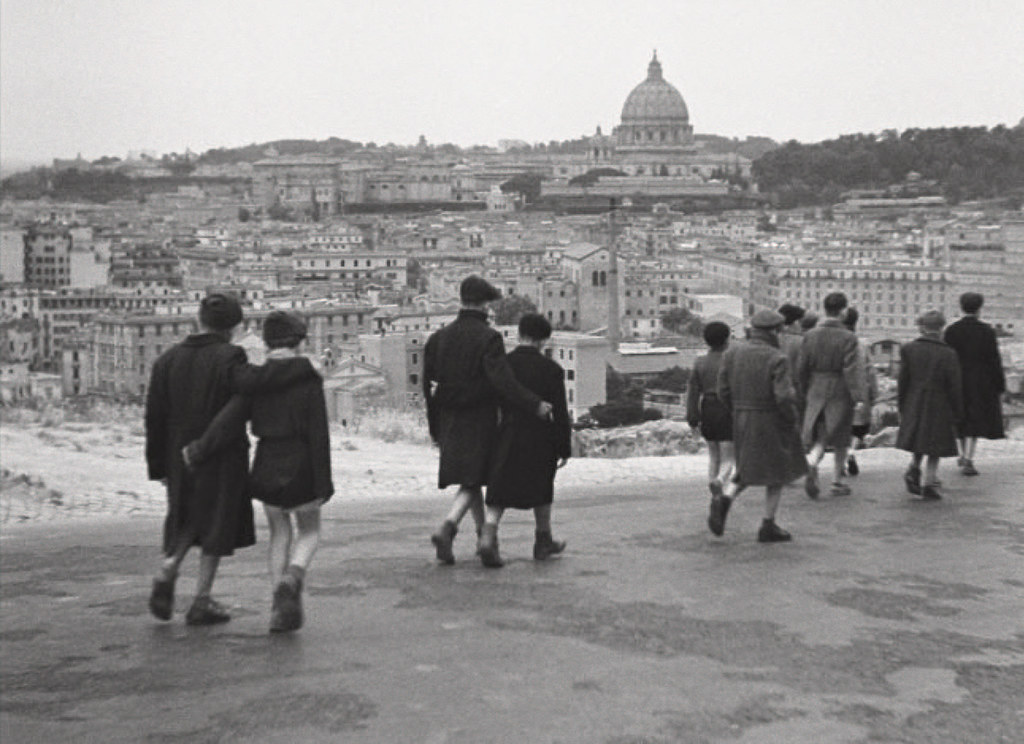
“All the anxiety and fear. Can’t Christ see us?”
In Nazi Occupied Rome, the Italian Resistance hide in plain sight. The children quickly pick up their revolutionary spirits; one evening, with the best intentions spurring them on, they blow up a petrol-tank, alerting the Gestapo of the whereabouts of one of the Resistance’s leaders.
Created immediately after the German Occupation of Rome ended, using leftover scraps of film reel, Rome, Open City was the first of Roberto Rossellini’s ‘War Trilogy’ and the only example that took place while there was a war still going on! Italy had surrendered to the Allied forces in October 1943 but German troops stayed there for a further 8 months (1 – for more on the history of Italy’s role in the war and Rome’s involvement). They left in June 1944, the idea for the film was conceived in August and filming began in early 1945.
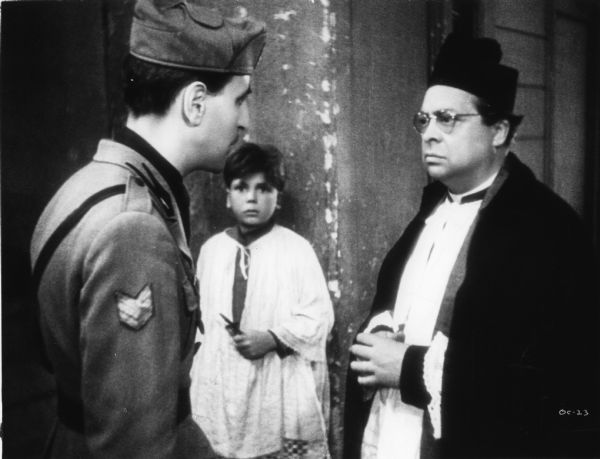
Rossellini was driven by a desire to expose the brutalities and indignities suffered by Romans (2), including the sad and true story of a priest who forged documents for the Resistance, played by Aldo Fabrizi. With the memories of Occupation still fresh to the people of Rome, Fabrizi recalls that on the day of shooting his arrest, a tram was going by. A man on board, presumably not noticing the cameras, saw several people in German uniforms manhandling a Catholic priest and pulled out a revolver. Fabrizi began shoving the ‘Officer’, who was actually just the grip in costume, into the car and shouting ‘Don’t Shoot’! Happily, the crisis was averted and the scene was dubbed over with ‘Leave me alone’; it unsurprisingly plays out as a very realistic struggle (3).
“Hatred will destroy us. We don’t have a hope.”
Fabrizi and Anna Magnani were the most well-known names if not necessarily the leads. They were both comic actors at the time but perform their tragic roles beautifully. As Pina, Magnani is the fiercest lady in Rome, including the drug-pedalling German informant Ingrid. She has a notoriously sharp-tongue and is passionately protective of her son and fiancée. She wrestles with her faith, feeling guilty and trapped in her pregnancy, all the time exuding warm optimism for the benefit of her family (4).
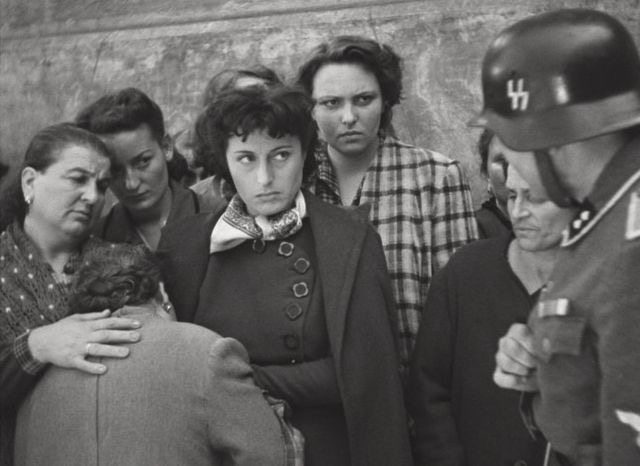
The film’s tone shifts when one of the characters is shot dead in the street. The Italian reaction to the film’s premier was lukewarm (5), the people favoured escapism and were evidently not eager to see their recent turmoil on the big screen. Yet it won a prize at the Cannes Film Festival and when it arrived in America, in the backpack of a returning soldier, it was a Box Office hit. It was heralded as the birth of neo-realism, generating a tapestry of real stories to create the characters and plot.
Without being aware of its context, it’s a very moving film about a place in World War history that I feel is largely forgotten about. However, with the background and foundations in mind, it is one of the best war films there is. The uniqueness of filming on location in bombed buildings, during a time when in-studio filming was more popular, and given the danger still arguably imminent creates a palpable tension. It surprised me. I laughed unexpectedly and gasped in shock (honest), and came away utterly perplexed at how underrated it is. I would recommend watching the restored edition, as the cocktail of film reels that were used for the original make for a difficult viewing, but mainly because it deserves it.
–
Rome, Open City. (1945). Film. Roberto Rossellini. Dir. Italy: Excelsa Film.
- Elly Farelly. ‘June 1944 – Rome Falls to the Allies in the Second World War’. War History Online. 28 May 2017. https://www.warhistoryonline.com/world-war-ii/fall-rome-fight-italy-m.html
- Jonathan Rosenbaum. ‘Rome, Open City: History as Adventure.’ Roberto Rossellini The War Trilogy booklet. 2015.
- The Children of Rome, Open City. (2005) Film. Laura Muscardin. Dir. Italy: Nuvola Film.
- Arun Kumar. ‘Rome, Open City (1945) Review – A Powerful Lament on the Quiet Defiance of War-Affected Italians’. High on Films. 17 Feb 2020. https://www.highonfilms.com/rome-open-city-1945-review/
- Geoff Andrew. ‘Rome, Open City: what makes a classic?’ BFI. 24 Apr 2019. https://www.bfi.org.uk/news-opinion/news-bfi/features/rome-open-city-what-makes-classic
Rome, Open City is available on DVD and Blu-Ray. See Find the Films for where to watch or buy it.
 Cine-Blah