
“He’s like royalty in exile”
The Motorcycle Boy Reigns. On the walls of derelict buildings and forgotten alleyways his memory haunts those who he left behind; those who loved him, those who feared him and those who idolised him. His return spells chaos for Rusty-James; obsessed with reputation and pining for the good old days of gang warfare, Rusty-James is faced with the crumbling sanity of his hero, the brother he doesn’t recognise.
In theory Francis Ford Coppola’s name attached to any film should generate a buzz, but not only is this film little heard of, it was a Box Office disaster. With a budget of $10 million, the film made less than $2.5 million worldwide (1) – although it appears to have had next to no release outside of the US initially. But this came after the incredible success of The Godfather (1972) and Apocalypse Now (1979) so why wasn’t it seen? Separating Coppola’s work into two distinct types, one set of films that are of a classic Hollywood style and comparatively mainstream and another more personal and artistic (2), Rumble Fish certainly falls into the latter category and might explain why it didn’t hit those familiar notes with audiences.
Regardless of its reception, Coppola claims Rumble Fish is in his top 5 favourite films that he made (1), probably because it had significant personal meaning to him. He dedicated the film to his older brother August whom he considered his ‘best and wisest teacher’, shadowing the dynamic which appears on screen. He gave his nephew, Nicolas Cage, his debut film role as well as August’s old Wild Deuces social club jacket to wear in the film (3).
At first, Rumble Fish was a short story by S. E. Hinton written in 1968, expanded into a novel much later. She has a cameo role in the film, appearing briefly as a prostitute (3). Hinton also worked on the screenplay with Coppola during days off from filming another adaptation of one of her books: The Outsiders – released in the same year and more financially successful, The Outsiders was still trashed by the critics at the time.
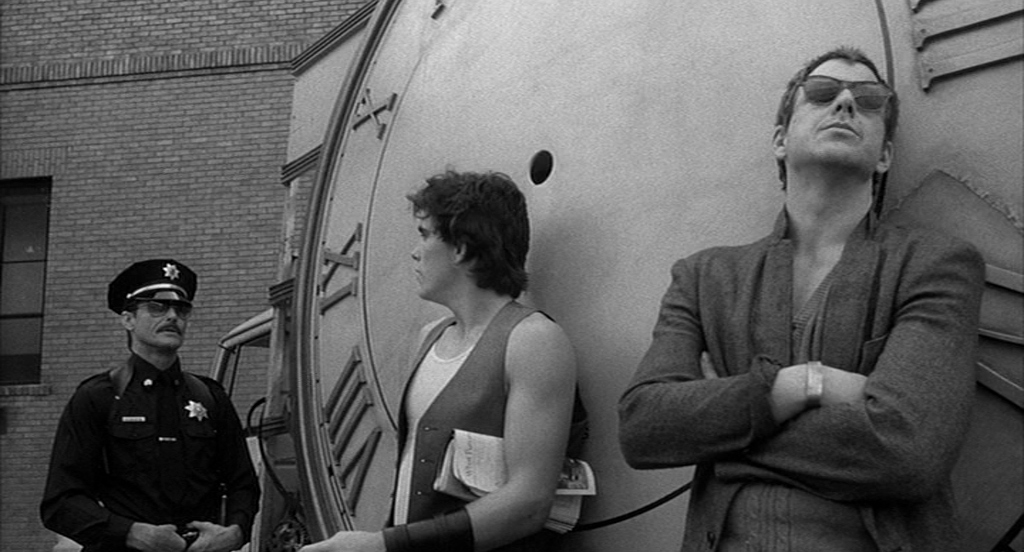
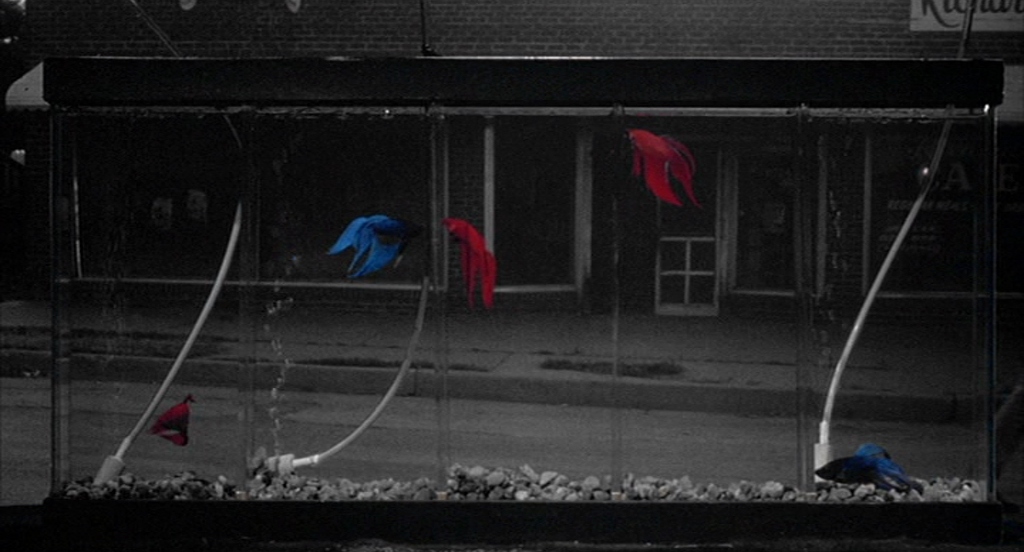
What is particularly admirable about how the film looks, not simply its being in black and white, is how stylish it is. Coppola employed Michael Smuin of the San Francisco Ballet to choreograph the fight scene which it starkly reminiscent of West Side Story. It’d be impossible to fail to notice the countless examples of symbolism: from the fast-moving clouds and passing shadows to smoke, reflections and various bodies of water, all signifying the loss of time and lack of freedom. More obviously is the regular inclusion of clocks and of course the fact that the actual rumble fish which the Motorcycle Boy wants to save are the only part of the film in colour.
“I don’t think they’d fight if they were in the river”
This film was totally new to me when I watched it this week and I only wished I’d seen it sooner! Touching on mental illness through the stifling setting of teenage gang culture, I was impressed by how vulnerable these outwardly tough characters were allowed to be. Whether they sink or swim depends on how they deal with their trauma and what they do next.
–
Rumble Fish. 1983. (Film). Francis Ford Coppola. Dir. USA: Zoetrope Studios.
- ‘Rumble Fish’. IMDB. https://www.imdb.com/title/tt0086216/?ref_=tttr_tr_tt
- Brian Greene. ‘Page to Screen: Rumble Fish & The Outsiders’. Criminal Element. 25 Apr 2017. https://www.criminalelement.com/page-to-screen-rumble-fish-a-the-outsiders/
- Curtis Tsui. ‘Ten Things I Learned: Rumble Fish’. The Criterion Collection. 25 Apr 2017. https://www.criterion.com/current/posts/5597-10-things-i-learned-rumble-fish
Rumble Fish is available on DVD and Blu-Ray, I recommend getting the sharpest quality version you can as it’s such a visual treat! See Find the Films for where to watch or buy it.
 Cine-Blah